Video studio
Say it out loud. Get a film back.
Speak a rough idea. It writes the script, directs it into scenes, draws a still for each one, and films them.
How does an idea become a film?
You talk. It writes that down, turns it into a script, breaks the script into scenes, draws a still for each one, then films them one at a time.
You speak
A rough idea, out loud, in ordinary words. No format, no brief.
It writes the script
A whole pass that does nothing but write.
A second pass directs it
Scene by scene: what happens, where the camera is, what is in frame, who says what, how long it runs, what it sounds like, and the frame it ends on.
It draws each scene
A still per scene, so you can see the film before it costs anything to make.
It films them
One clip per scene.
Why is this better than one long prompt?
Because the writing and the directing are separate passes. Ask one AI for "a script and the shots" and you get a script with the shots ignored, every time. So it writes first, then directs what it wrote.
- Writer and director then argue it out. The director sends notes back; the script changes.
- A third pass criticises the result the way a marketing lead would, before anything is filmed.
- All of this happens on the still images, which cost nothing, before you pay for a single second of video.
Can the same character appear in every scene?
Yes. You can generate a character who stays the same from scene to scene, so a film about one person actually looks like one person.
To be clear about what this is not
Their mouth does not match the words. This is the same character appearing throughout, not a talking avatar. If you need lips in sync with audio, this will not do it.
Can it use my voice?
Yes, on Windows only, in six languages: English, French, German, Portuguese, Italian and Spanish. You have to record consent first, and a voice with no recorded consent cannot be used at all.
There is no Android path for this one. If you are on the Android build, the read-aloud voices are not available to you.
Can I edit the result?
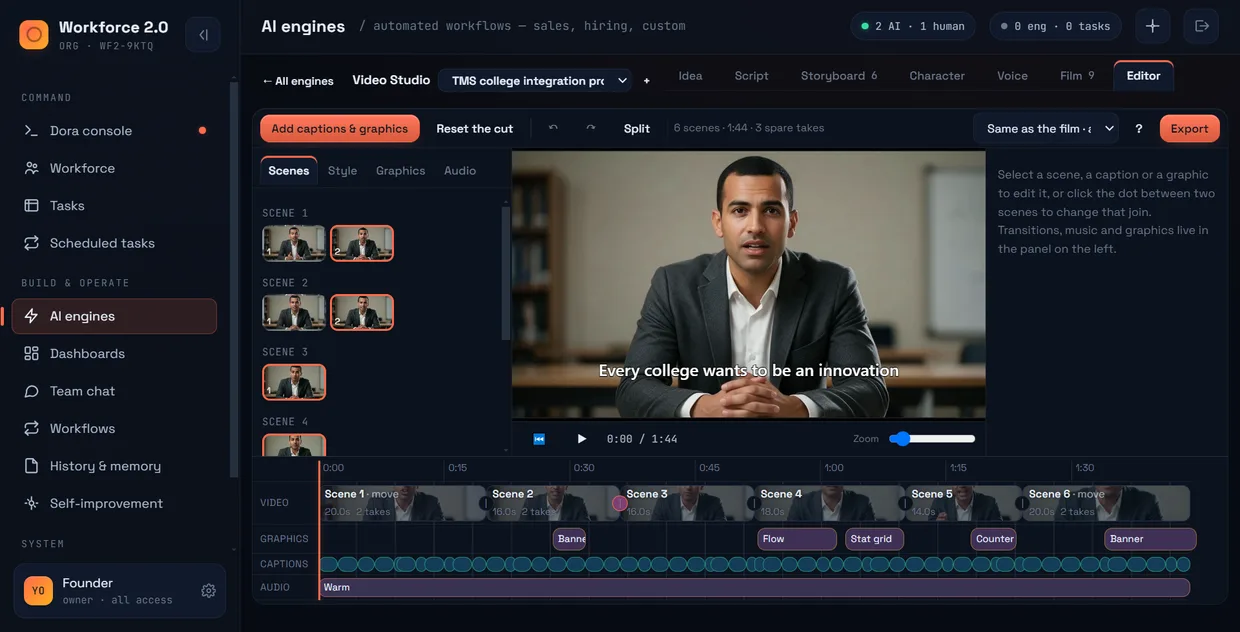
Yes. There is a proper timeline editor, not just a render button. Four tracks, and everything on them is yours to move.
Captions
Styled caption presets, placed and timed on the timeline.
Graphics
Lower thirds, lists, numbers, comparisons. Drag to place, drag the corner to size.
Music
Its own track, mixed under the film.
Shape
Cut the same film for a vertical reel or for widescreen. The choice is part of the edit and it is remembered.
How do I get one file out?
It joins the scenes into one file and repacks it so other programs will open it, not just this one. You get something you can hand to a client.
How long it takes, said before you press it
Saving is a real re-encode in the browser, so a three-minute film takes about three minutes. The button says so before it starts, because a progress bar that surprises you is worse than a wait you agreed to.
The first export downloads its tools
The part that does the encoding is 79 MB, and it is not in the installer, because most people never make a film and it would have doubled the download for everyone. The first time you export, it fetches it once and keeps it. After that there is nothing to wait for.
One limit worth knowing
Scenes do not flow into each other frame by frame. Each clip is filmed on its own, so you get cuts between scenes rather than a continuous camera move across them.
What does it cost?
€0.05 to €0.20 per second of film, depending on quality. Writing, directing and storyboarding cost nothing extra. You only pay when you actually film something.
There is no monthly plan for this one, deliberately
We are billed by the second for rendering. A flat fee covering unlimited video would be a promise we could not fund, so we do not offer one. We would rather say that plainly than sell a plan we would later have to put limits on.
Questions
How long can a film be?
It is built scene by scene, so length is a question of how many scenes you want and what you want to spend, not a hard cap.
Can I redo one scene without redoing the film?
Yes. Scenes are separate clips, so you can refilm one and leave the rest alone.
Can I use my own footage?
The studio is built around generating the scenes. The timeline is where you would assemble anything else.
Do I need a good graphics card?
No. The filming happens remotely. Saving the final file happens on your machine, which is why it takes about as long as the film.